Proč už nepodporujeme prohlížeč Internet Explorer

Prohlížeč Internet Explorer již nepodporujeme a také důrazně nedoporučujeme, protože dlouhodobě funguje bez zásadních aktualizací, vylepšení a podpory. Obsahuje řadu závažných bezpečnostních rizik, které mohou způsobit únik citlivých informací a vašich osobních dat. Nehledě k tomu, že prohlížení a práce s webovými stránkami je v něm pomalejší až o 50 % v porovnání s ostatními prohlížeči.


Které prohlížeče tedy používat a kde si je můžete stáhnout?

Změna prohlížeče je jednoduchá, nezabere vám moc času a my vám s ní pomůžeme. Nachystali jsme pro vás seznam doporučených prohlížečů.

Vyberte si prohlížeč a klikněte na jeho název. Otevře se vám stránka, na které si prohlížeč můžete bezpečně nainstalovat.

TIP: Klidně si můžete nainstalovat všechny a vyzkoušet si, jak se vám s nimi pracuje.

A nebojte se, že změnou přijdete o všechny záložky, historii a uložená hesla. Můžete si je totiž jednoduše přenést. Postup pro dva nejpoužívanější prohlížeče přidáváme.

Doporučené prohlížeče:

Mozilla Firefox je výkonný, stabilní a bezpečný prohlížeč. Záložky a další data si můžete přenést podle návodu zde.
https://www.mozilla.org/cs/firefox/
https://support.mozilla.org/cs/kb/import-zalozek-dalsich-dat-z-internet-exploreru-ne

Google Chrome je rychlý, jednoduchý a bezpečný prohlížeč. Podívejte se na návod, jak přenést záložky a ostatní informace do Google Chrome.
https://www.google.com/intl/cs_ALL/chrome/security/
https://support.google.com/chrome/answer/96816?hl=cs
Congratulation to Snehasis on successfully defending a PhD thesis. Snehasis's PhD was about unravelling the reaction pathways in hydrodeoxygenation (HDO) of anisole and guaiacol over non-noble metal catalysts. The work started with Ni/Al₂O₃. In a Journal of Catalysis article (2024), where he has combined flow-reactor data, thermodynamic analysis and adsorption studies to work out what the acid and metal sites each do. It showed that benzene forms through hydrogenation–dehydrogenation equilibria, not through direct deoxygenation. Further work revealed that replacing Ni with Cu enhances the selectivity of transfer alkylation (Catalysis Today, 2025). In Cell Reports Physical Science (2026), Snehasis used kinetic modelling to measure how Cu in Ni–Cu catalysts shifts selectivity toward deoxygenated and alkylated products. Most recently, a Chemical Engineering Journal article (2026) looked at how SBA-15 and AlSBA-15 supports and their acid sites influence anisole HDO. A further manuscript on Langmuir–Hinshelwood microkinetic modelling is under review in Reaction Chemistry & Engineering. In it, Snehasis estimated the kinetic parameters using both nonlinear regression and Markov chain Monte Carlo, a Bayesian method. This work was developed during an Erasmus visit to Prof.Dmitry Murzin's laboratory atÅbo Akademi Universityin Turku, Finland. Snehasis Duttaextends special thanks to PhD supervisor David Kubičkafor the guidance, patience and trust throughout this journey. We're proud to have been part of this journey, and we wish Snehasis all the best for the next chapter!

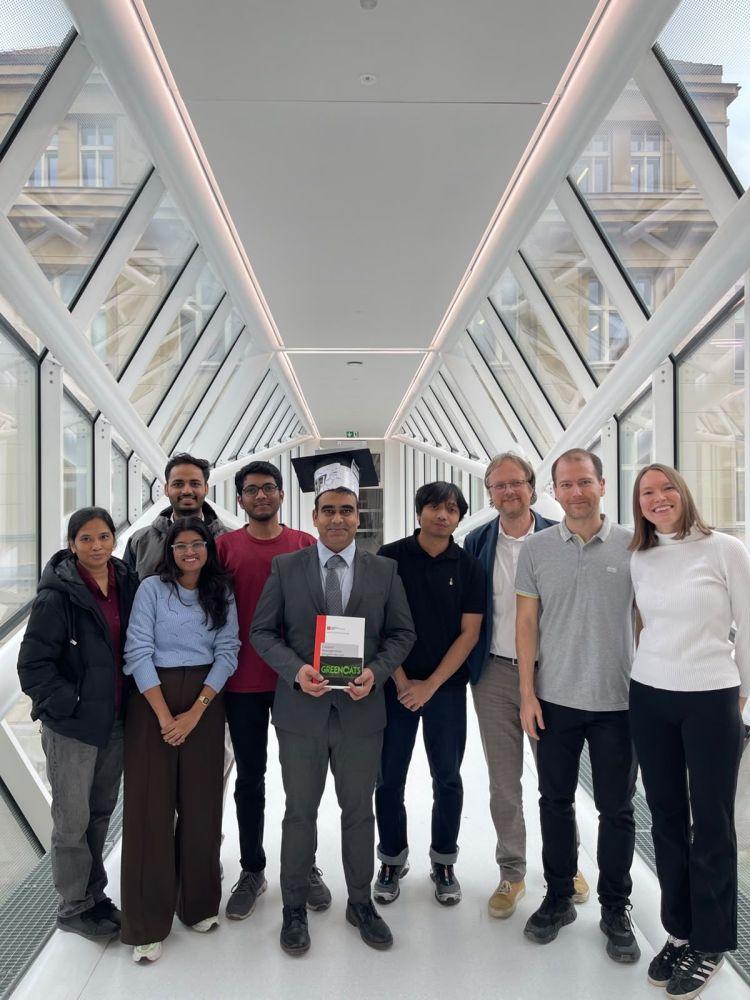

Snehasis's PhD was about unravelling the reaction pathways in hydrodeoxygenation (HDO) of anisole and guaiacol over non-noble metal catalysts. The work started with Ni/Al₂O₃. In a Journal of Catalysis article (2024), where he has combined flow-reactor data, thermodynamic analysis and adsorption studies to work out what the acid and metal sites each do. It showed that benzene forms through hydrogenation–dehydrogenation equilibria, not through direct deoxygenation. Further work revealed that replacing Ni with Cu enhances the selectivity of transfer alkylation (Catalysis Today, 2025). In Cell Reports Physical Science (2026), Snehasis used kinetic modelling to measure how Cu in Ni–Cu catalysts shifts selectivity toward deoxygenated and alkylated products. Most recently, a Chemical Engineering Journal article (2026) looked at how SBA-15 and AlSBA-15 supports and their acid sites influence anisole HDO.
A further manuscript on Langmuir–Hinshelwood microkinetic modelling is under review in Reaction Chemistry & Engineering. In it, Snehasis estimated the kinetic parameters using both nonlinear regression and Markov chain Monte Carlo, a Bayesian method. This work was developed during an Erasmus visit to Prof. Dmitry Murzin's laboratory at Åbo Akademi University in Turku, Finland.
Snehasis Dutta extends special thanks to PhD supervisor David Kubička for the guidance, patience and trust throughout this journey.
We're proud to have been part of this journey, and we wish Snehasis all the best for the next chapter!